
Halloween Night Driving: A Vehicle Preparation Checklist
In this guide: Prepare your vehicle for Halloween evening with practical checks for lighting, tires, portable starting power and a clear roadside kit.
Halloween evening can mean unfamiliar streets, parked vehicles and more people around the curb. Preparing the car before leaving gives you fewer equipment decisions to make after dark. This checklist focuses on the condition of your vehicle and the tools you can realistically use, rather than on decorative accessories.
Check the lights already on the car
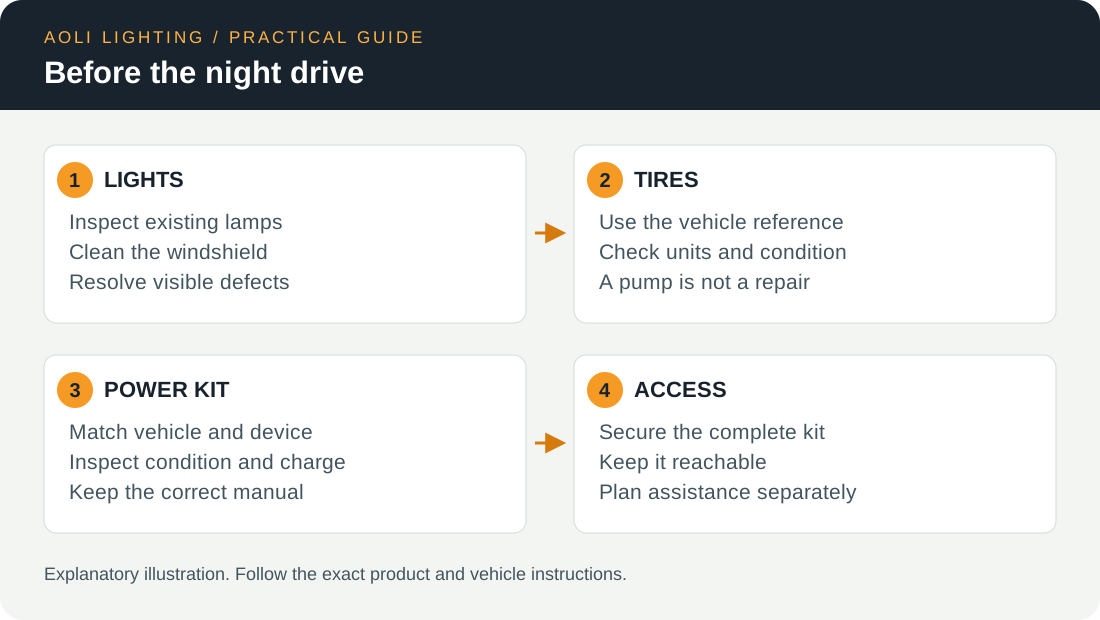
Walk around the parked vehicle with a second person operating the controls. Check low beams, high beams, indicators, brake lights and reversing lights. Clean the lamp covers and windshield. A new bulb will not correct a dirty lens, damaged wiring or a poorly aimed headlamp, so resolve those issues before shopping for upgrades.
Keep decorations away from essential equipment
If you decorate a vehicle for a stationary event, keep coverings and cables clear of the lamps, driver’s view, ventilation openings and moving parts. Remove anything that can loosen before driving. Decorative lighting should not be treated as a substitute for vehicle lighting, and colored decorative effects should not be used to choose a road headlamp.
Prepare tire and battery tools while parked
Find the tire-pressure information for your vehicle and locate the valve caps before you need an inflator. Check the charge indicator on your portable jump starter and read its exact manual. A combination starter and compressor can reduce the number of separate tools you carry, but each function still has its own limits and instructions.
Pack for the stop, not only the drive
Store a flashlight, phone charging cable and vehicle information where they can be reached without emptying the boot. Secure heavier equipment so it cannot slide around. Before leaving, decide where you would stop if something felt wrong. Equipment is most useful when you can access it from a suitable stopping place.
Explore equipment for your vehicle
Browse our all in one jump starters collection. One reference model to review is the CS02-PRO 8250A Pro Car Battery Jump Starter with Air Compressor. Compare its specification table and confirm the exact configuration, included accessories and suitability before ordering. If a detail is missing, send Aoli Lighting your vehicle and model information.
Should I buy new LED bulbs immediately before Halloween?
Only after confirming the correct fit and allowing time for installation and beam checks. A last-minute purchase is not a substitute for checking the lights already fitted.
More Aoli Journal guides · Current holiday event dates and delivery information
Plan the evening around visibility, access and a suitable stopping place
A Halloween journey often combines several short trips: collecting family members, visiting an event, parking on an unfamiliar street and returning after dark. The equipment question is therefore broader than which product has the largest rating. Think about what you need to see, what other road users need to see, and whether the roadside kit will remain accessible after costumes, bags or event equipment have been loaded. Write the route and the likely parking arrangements down before packing.
Start with the vehicle in daylight. Check the lamps already fitted, windshield condition, mirrors and the view around any decorations. Ask another person to operate the brake lights and indicators while you observe from a suitable position. The purpose is to identify an existing fault, not to justify an immediate upgrade. A replacement LED bulb cannot correct every damaged lens, electrical problem or alignment issue. If something is wrong, resolve the actual fault before treating the car as ready for an evening event.
The stopping environment also matters. A portable starter or inflator is useful only when the task can be carried out appropriately. A busy traffic lane, unstable surface or location where occupants cannot remain safely away from traffic is not made suitable by owning a tool. Plan whom to contact and where assistance can reach you. Make this decision before an equipment problem, rather than allowing the presence of a new gadget to dictate whether you attempt a roadside task.
Use a staged preparation routine rather than a last-minute experiment
The first stage is identification. Locate the correct manual for each device and check its model against the case or label. Identify the vehicle’s relevant battery system, designated starting points and tire-pressure reference using the vehicle instructions. You should know where this information is before leaving, even if you do not expect to use the equipment. A video for an older starter can explain the general category without being the operating procedure for your current unit.
The second stage is a nonoperating inspection. Check charge indications, visible cable condition and whether the matching hose and adapters are present. Keep clamps protected and separated, and do not connect the starter merely to demonstrate it to passengers. For an inflator, identify the units and target-setting controls while you have time to read the instructions. If a setting or warning is unclear, ask for model-specific help before the trip rather than trying different buttons during a problem.
The third stage is packing. Put the correct cables with their device and keep the case accessible without unloading the vehicle into traffic. Secure the equipment appropriately; a loose case should not slide around the passenger area. Save the product manual and support details where they can be reached if mobile reception is poor. After the event, inspect the kit again if it has been used, borrowed or moved. Returning it to storage without checking charge or missing parts only postpones the preparation problem.
Two planning examples: a family car and a working van
Consider a family using a conventional passenger car with a documented 12V battery system. They want backup starting assistance and occasional tire top-ups, and the boot is full of event supplies. A combination unit may suit the storage plan if its exact starting application, tire limits and case dimensions are confirmed. Their useful preparation is to check those facts, organize the case and record the pressure values. It is not to assume that the starter fits because the family car looks smaller than a vehicle shown in advertising.
Now consider a driver attending several events in a delivery van. The van’s electrical arrangement, engine application and tire pressures need separate confirmation. If those details are not established, borrowing the family’s starter is not a completed compatibility check. A higher peak-current title on another product would not answer the voltage question either. The driver should obtain the current vehicle information and supported-product limits before selecting equipment, particularly if the van has a different battery arrangement or commercial-duty requirements.
These are planning examples, not reports of tested vehicles. Neither example establishes a make-and-model fitment list for the CS02-PRO, F40 or another reference product. The information to send Aoli is the vehicle year, model, engine or powertrain, relevant system voltage, tire size where inflation is involved, and the precise product under consideration. That turns an everyday scenario into a checkable request rather than an unsupported promise about every car or van.
Troubleshooting decisions that belong in the plan
If the starter does not show its expected ready indication, do not turn the evening into a sequence of repeated starting attempts. Record the charge indication and warning text, then follow the exact device and vehicle instructions. A dark display, clicking sound or unsuccessful start can have more than one cause. A starter is not a general diagnostic instrument, and a functioning flashlight on the same case does not prove that the starting function is ready for the vehicle.
If the inflator runs but the pressure does not behave as expected, stop and inspect the setup only when it is appropriate to do so. Confirm the selected units, valve connection and permitted task. A damaged tire, recurring air loss or unclear condition needs a suitable tire professional; the pump is not a repair. If a compressor stops under protection, use the actual rest and inspection instructions rather than guessing a universal waiting period. The next action should follow the observed condition, not the desire to keep the trip on schedule.
For lighting problems, distinguish a failed lamp from a beam that is poorly aimed, an obscured lens or an unsuitable installation. Do not install an unverified bulb in a hurry solely because an event has already started. Ask an installer to assess the actual assembly if needed. The objective of the checklist is to reduce uncertainty before driving, and sometimes the correct outcome is to postpone an upgrade or obtain assistance instead of using a product immediately.
| Before leaving | What to record | If the answer is missing |
|---|---|---|
| Vehicle lights | Which lamp was checked and any observed defect | Resolve the fault; do not substitute decorative lighting |
| Starting kit | Exact device model and vehicle-system match | Request model-specific confirmation before connection |
| Tire equipment | Vehicle pressure reference, units and supported task | Confirm the pressure and tire condition before inflation |
| Packed access | Case location and matching accessories | Repack before the journey instead of relying on roadside unloading |
Build a vehicle record before choosing equipment
Write a vehicle record that another person could use without guessing: manufacturer, model, model year, engine or powertrain, market, relevant battery system, and the task you want the equipment to perform. Include a photograph or transcription of the identifying label when it is accessible without dismantling or touching unsafe components. This record is more useful than a message saying that the vehicle is a large SUV or a small car. Those descriptions leave too many installation and electrical questions unanswered.
Treat a familiar vehicle name as the beginning of the investigation. Different years, markets, trims and previous repairs can change the equipment actually installed. A lamp assembly may have been replaced, a vehicle may have a nonstandard tire size, or a battery arrangement may differ from what an online discussion assumes. The current vehicle documentation and installed components take priority over another owner’s anecdote. Where those references disagree, have a suitable technician resolve the discrepancy.
Separate confirmed facts from open questions. For example, “the owner’s manual identifies a 12V auxiliary system” is a fact you can record; “every battery-equipped vehicle can use this starter” is an unsupported conclusion. Similarly, knowing that a lamp uses H7 does not establish rear clearance, optical compatibility or local approval. Send the confirmed facts and the remaining questions together when requesting product help. A clear record lets the supplier explain what still needs checking rather than offering an overbroad assurance.
Separate the vehicle’s tire target from the inflator’s rating
The target for tire pressure belongs to the vehicle’s specified tire and load conditions. Find that information in the vehicle instructions or pressure placard, then check whether front, rear and loaded-use values differ. An inflator’s maximum rating is an equipment limit, not the target for every tire. A number printed on a sidewall also serves a different purpose from the vehicle’s recommended operating pressure. If the wheels or tires have been changed, have the correct reference confirmed for that setup.
Use consistent measurement conditions and units. Note whether the vehicle instructions call for a cold-tire check, identify the units shown on the inflator, and set the intended value deliberately. A display that measures one range does not necessarily mean the pump can inflate throughout that range. A high maximum-pressure claim also does not tell you how long a particular tire will take to fill, whether its valve can be reached or what rest periods the compressor requires.
Inspect the visible tire and connection before using the pump. An inflator is not a repair for a damaged tire, nor does adding air establish that a tire with a recurring loss is suitable for continued driving. Use professional inspection when the condition is uncertain. After an appropriate inflation task, check the result with a suitable gauge and follow the device’s shutdown instructions. Record an unusual loss or repeated warning instead of repeatedly topping up without investigating the underlying reason.
Make storage and maintenance part of the purchase decision
Consider the packed equipment rather than just the bare device. A case may need room for clamps, a hose, adapters, charging equipment and the manual. Measure the space where the whole kit will go, then check that it can be secured and retrieved without interfering with occupants or controls. A compact product is not necessarily convenient if its required accessories are stored elsewhere or its case cannot be opened in the chosen compartment.
Use the device’s actual storage and charging instructions. A temperature range for operating a product is not automatically its permitted charging range, and a photograph of equipment in a car does not establish suitability for every climate. Arrange a routine that lets you inspect the kit and recharge it under supported conditions. Check it after use and after another person borrows it. Missing accessories and a reduced charge are easier to address at home than during an unfamiliar stop.
Keep model-specific items together. Similar-looking plugs or clamp cables should not be mixed between starters without explicit compatibility confirmation. Protect contacts and avoid storing loose conductive items where they can contact the equipment. A simple inventory inside the case helps identify missing parts. Include the exact model and a way to access the correct manual, so that another household driver can find the operating instructions instead of improvising from memory or following a guide for a different version.
Recognize when equipment use should stop
A warning, unusual smell, visible damage or unexpected heat is a reason to stop the task and reassess the equipment. It is not a challenge to defeat a protection feature. If there is smoke, swelling, leaking material, fire or another immediate hazard, keep people away and obtain appropriate emergency assistance. Do not handle a hazardous device just to complete a checklist or to reproduce a fault for a photograph. Ordinary product troubleshooting begins only after immediate safety is established.
For a nonhazardous problem, record what happened before changing anything: device model, charge indication, selected function, connected accessory and exact warning message. A clear description can distinguish a setup question from a damaged component or unsupported application. Avoid repeatedly reconnecting, cranking or inflating when the instructions do not authorize another attempt. Waiting a guessed number of minutes does not establish that a damaged device has become safe to reuse.
Return to the model-specific manual and the vehicle’s instructions. Different revisions can use different indicators, connection sequences and limits; generic blog advice should not override them. If the issue remains unresolved, provide the recorded details to the supplier or a qualified vehicle professional. Do not substitute an unrelated cable, open the battery pack, bridge protection contacts or use a mode you do not understand. Stopping with a useful fault record is a better outcome than making the original problem harder to diagnose.
Reference models to examine for this task
Use the following models as starting points for Halloween night driving checklist. These are catalog comparisons, not bench-test results, endorsements of every printed claim or a vehicle-specific fitment certificate. Check the exact supplied version before ordering. The photographs retain their original reference branding, and any original supplier service offer is separate from Aoli Lighting’s actual order terms.
CS02-PRO 8250A Pro Car Battery Jump Starter with Air Compressor

| Catalog field | Reference listing |
|---|---|
| Product type | Jump starter with air compressor |
| Battery Cell Composition | Lithium-ion Battery |
| Voltage | 12 Volts |
| Vehicle Service Type | Car, Pick up truck, lawn mower, Tractor |
| Battery Capacity | 48840mWh (Lithium) / 13200mAh 3.7V |
For this comparison, first identify which of the listed fields answers your immediate question about Halloween night driving checklist. Read each row with its units and stated basis intact. Missing dimensions, application limits or package information should remain questions for the supplier; they are not permission to infer a universal fit. If a title and table differ, resolve the exact specification for the unit you would receive before ordering.
F40-10200A Pro Jump Starter Car Fast-charging PD-100W 12V 24000mAh Power Bank Battery Booster

| Catalog field | Reference listing |
|---|---|
| Battery system | 12V |
| Capacity (source rating) | 24000mAh |
| Charging (source listing) | PD 100W |
| Battery Cell Composition | Lithium-ion Battery |
| Voltage | 12 Volts |
For this comparison, first identify which of the listed fields answers your immediate question about Halloween night driving checklist. Read each row with its units and stated basis intact. Missing dimensions, application limits or package information should remain questions for the supplier; they are not permission to infer a universal fit. If a title and table differ, resolve the exact specification for the unit you would receive before ordering.
A five-minute handover before the family leaves
Ask the person who packed the vehicle to explain the kit to another driver. They should be able to identify the main case, matching accessories and location of the correct instructions without unloading the boot. Ask which checks were completed that day and which details remain unconfirmed. This short conversation can reveal a missing cable, a blocked compartment or a misunderstanding about the vehicle before the journey starts.
Give each observation an action. A lamp that failed the walk-around needs an appropriate repair decision. A starter with an unclear indication needs its exact instructions or support. An unfamiliar tire-pressure value needs confirmation from the vehicle reference. Do not put every issue into a single category called emergency preparation, because these tasks may require different people and different information.
After the event, repeat the handover briefly. Note whether the kit was used or moved, whether another person borrowed a part and whether the charge was checked again. This closes the loop on a busy evening when small uses are easy to forget. The practical measure of readiness is not how many functions are listed on the case; it is whether the equipment, vehicle match and information remain known when another driver needs them.
A ready-to-adapt question for product support
Use the following message as a starting point, replacing the vehicle and order references with your actual confirmed details. Keep payment information out of an ordinary product inquiry.
Before our Halloween evening trip, I would like to confirm a roadside kit for the vehicle described in my record. Please check the exact starter application and supplied clamp assembly, and separately confirm the intended tire top-up task. I also need the correct current manual and package list so another household driver can identify the equipment. Please tell me which details remain unconfirmed rather than assuming that a combination unit suits every function. I will check the vehicle’s lights and pressure reference separately and will not treat decorative accessories as a replacement for those checks.